
Gerd Butzeck: My Story, My Love and Life for Handball
Originally, my parents wanted to send me to gymnastics, but I can assure you that it was definitely not my sport. Then I went to handball with my friends from school. I come from handball-crazy town Solingen in Germany, and at school, we almost only played handball during sports lessons. I liked the sport, joined a club, and played handball throughout my youth. I was a playmaker, but honestly speaking, I was not the best player. Therefore, I decided to become a handball referee.
At some point, I was both a referee and a player, and I also played chess. Then the head of the referees told me to make a decision about what I wanted to be. I opted to become a referee. When I was 16 or 17, in my hometown Solingen, we had about 20 handball clubs and 220 referees. Everybody played handball. Even at school, we had class-vs-class championships. Still today, it’s a handball town. We have three teams – men and women – playing in the first and second Bundesliga in my hometown.
I have a lot of friends from the old times. We meet every Tuesday at the Kaffeehaus to talk about handball. We even have a team of seniors called the Kaffeehaus Jumbos. Famous players belonged to our team, like Andreas Thiel, the famous German goalkeeper, or Erhard Wunderlich, who has already passed away. With this team, we participated in the first-ever European Masters tournament for players over 45. It was a lot of fun and really good. Handball deserves more tournaments like this one.
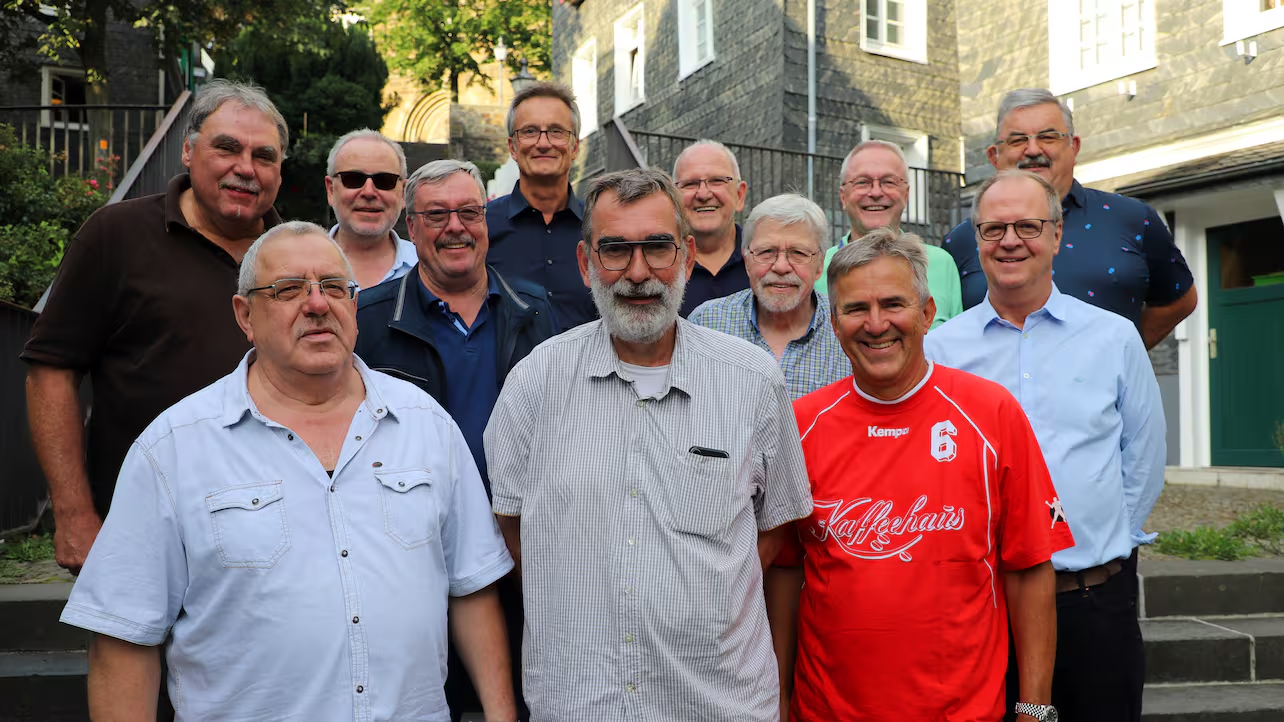
(Source: Solinger Tageblatt)
Handball is everything in my life. I’ve been living handball all my life, and it has always been the most important thing to me. It was the most important 50 years ago, 40 years ago, 30 years ago, and it still is today and will be in my future. My whole life has been influenced by handball – even the major decisions in my life were influenced by handball. At the start of my business career, I had two opportunities: one was to become a mathematician in an insurance company, and the other was to become the manager of a professional handball team. Back in 1985, there were no professionals in the organization around handball. At that moment, I had to make a crucial decision that determined my entire life.
I decided to become the first-ever professional manager of a club team in Germany, Milbertshofen in Munich, the team of Erhard Wunderlich, who was voted ‘player of the century’ in Germany, or Mile Isakovic and goalkeeper Jan Holpert, who played many caps for Germany. I had one week to think it over – mathematician or handball manager. But my love for handball was bigger, so I thought I could contribute to the growth of handball. This was the starting point of my professional career in handball.
Now I have three grandchildren, and I insist that they play at least one team sport, preferably handball, of course. A team sport is crucial for the development of personality and important for development in life. I believe that social competence is built during a career in a team sport. I recommend all parents send their children to a team sport club. If you have the talent to become a professional player, grab this chance. Even if you are not the best player, there are many options to work in handball – you can become a coach or a referee, but the most important thing is to stay in handball. You can work in various functions – as a handball official, in handball media, marketing and many more. Handball is always looking for people who are genuinely interested in our sport and care about handball as a whole.
I’m now 66 years old, and I’m still involved in handball.
What I also learned is how important it is to think outside the box and experience other cultures. I traveled a lot around the world, and at a very young age, I decided to study mathematics, Russian language, and pedagogy abroad. I spent about half a year in the US and later about a year in the Soviet Union, and that was at a time when there was no internet and no mobile phones, so it was really different compared to today. At the same time, I think these stays abroad were perhaps the most important periods in my life. There were very few foreigners in the Soviet Union at that time. We still had the Iron Curtain. I told my kids that they had to go abroad to develop their personalities, and they followed my example.
Without my time in Moscow, I would never have met the Soviet handball team, which I managed for about 10 years. At that time, the Soviets were at the top of handball along with Sweden, and we were extremely successful. Later, I was vice president of the Belarusian Handball Federation for 10 years. What I learned most in Belarus was that if you work hard, you can achieve anything. We achieved a lot, like the first-ever gold medals in Beach Handball at the European and World Championships. Being the parallel manager of the Munich club, this was the most exciting time of my career.
Since then, handball has become dramatically faster and more professional, with significantly more money involved. We have achieved quite a good level, which can, of course, be improved, but handball has become a very professional sport.
I like this development, but we have to consider that other sports are also developing, so we have to keep pace with them. The leaders in the world of handball need to monitor the development of competitors closely – basketball, volleyball, rugby, hockey. We have to compare ourselves with them and stay a step ahead. Our target must be for handball to become one of the top sports in the world.
Handball deserves more – than its current status.